

Karakorum is a title from Reiner Knizia about mountain climbing. It is a game about evaluating and taking risks, and knowing when to rest and claim progress. At the same it is also a race on several levels. The mountain climbing theme is pretty much pasted on. Story-wise you have three climbers each working on a different peak. You help them climb as far as possible, and you will score points based on their progress.

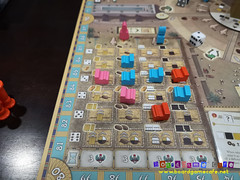
Everyone has one such player board with pawns in three colours. The three pawns will mark your progress in climbing the three peaks. The three peaks depicted here are a little misleading. To reach the summit in all three colours you need to hit 30 for all, not 10, 20, and 30 respectively.
To make progress in any of the three colours, you need to collect, play and trade-in cards. On your turn, you must reveal some cards from the deck – at least one, and at most one more than the number of players. Of these card revealed, you must take at least one, and you can take more than one as long as they are all of the same colour. Cards are in one of the three colours, and they are numbered between 1 to 9. Some cards show axes. Of the cards you don’t take, they are offered to everyone else. The other players may take one card each from what’s left. This mechanism means when you reveal many cards, you are increasing the chances of getting cards you want, but you are also increasing the chances of helping your opponents. If the first card you reveal is good for you, it is perfectly fine to not reveal any more and just take that card for yourself.

You must play the cards you claim in front of you. You can have four columns in front of you, one in each colour, and then one more can be a duplicate colour. Cards played to the same column must be in ascending order. Cards with the same number can be played next to each other. When you add a card to a column, and it now has at least three cards, you can trade that column in to make progress in that specific colour. The progress you make depends on the number of axes. In case you are forced to discard a column with fewer than three cards, you are penalised and your pawn moves backwards three steps. That’s very bad, because in this game it is not easy to make progress.

When you trade-in a column to make progress, if you fulfil one of the 12 public objectives with your column or columns, you can instead discard your column to make progress according to the rewards shown on these objectives. These are first come first served. Once an objective is claimed, it is turned face-down. The objectives are: at least four cards, two columns of three cards each, at least 6 cards, and at least 10 axes.
There are several dilemmas you have to face in the game. The first one is how many cards to reveal from the deck on your turn. Drawing more cards can help you more, but this can also help your opponents. You can only pick one colour, and sometimes you will be torn between two or even three colours, knowing that whatever you don’t take will become useful to others. Deciding whether to trade-in a column of cards is not always straight-forward. Should you wait for one or two more cards, so that you can make even more progress? However when you delay, it can mean a long wait before your next opportunity. This is an opportunity cost. Even choosing whether to take a card can be tough. If you have a red 1, will you take a red 4 as your next card? It will mean you lose the opportunity to play any more red 1’s to 3’s. This is a pretty simple game, but it presents many difficult decisions.
The end game scoring is interesting and has a Knizia-style twist. You are not just summing up your scores in the three colours. First, to be eligible to win, you must be the top scorer in one of the three colours (this reminds me of Samurai). If you are not a top scorer in anything, you are immediately eliminated. Among those who are still in contention, you score your two other colours. What this means is during the game you must make sure you lead in one colour, and at the same time you need to do well in the other two. If anyone is doing well, you can plot to eliminate him by denying him the top position. This is an interesting dynamic.
Karakorum is simple yet clever, and deserves more attention. I have not heard much about it at all.
Categories: Meetup




 Boardgamecafe.net