

Altay is a civilisation and 4X game built on a deck-building engine. It is played on a simple map. Each player starts with just one small village. They defeat barbarians around them and build new settlements, expanding their territory.

The map shows different terrain types. Specific terrain types that you control can help you boost your production of certain resources. Some territories with banners are worth bonus points and may be contested more fiercely. In this screenshot many territories still have defense tokens. These are the barbarians you need to defeat before you can settle those lands. These tokens are worth points, and some give you a resource when you claim them.

There are four different tribes in the game, and they have different starting decks. You can categorise this as a deck-building game, because everything you do is subject to the cards you draw. During the game you can buy better cards to improve your deck. There are ways to remove weak cards too.
Some cards simply generate resources for you. Resources not spent at the end of your turn will be converted to gold. In future turns, you can spend 5 gold to buy any single resource. It’s a poor exchange rate, so ideally you try not to have any leftover. Some cards allow you to build a new village or to upgrade one. Every player has a number of village tokens, and the game ends when one player uses all his tokens. In battle, when you defeat your opponent you take one of his village tokens from the map. These are worth points.

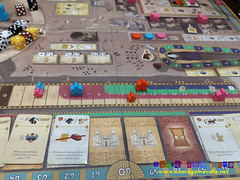
This is one example of a card you can buy. Some cards have point values (purple banner). This Worker card can produce one of three resource types. It gives you good flexibility.
Some cards allow you to attack or defend. You can attack either a neighbouring barbarian, or a neighbouring opponent village. The village you attack from counts for your attack strength, for example when attacking from a size 2 village (you can call that a town), your base strength is 2. When you are attacked, you can play military cards to defend yourself too.

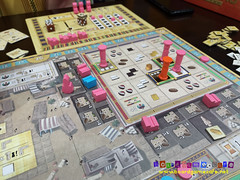
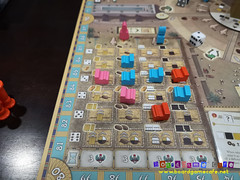
You are going to construct buildings for your civilisation. These are divide into three tiers. Each higher tier building must be supported by a lower tier building. You can never have more buildings of a higher tier than a lower tier. All buildings have special abilities, and the gold tier ones help you score points at game end. You also get your own unique gold tier building, and that’s something you can plan for from the start. You don’t necessarily have to build it, but since it’s something you already know from the start, you probably want to customise your play around it and plan to score many points from it.

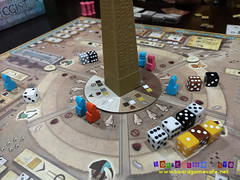
The Triumphal Arch is a gold tier building – a monument. Buildings often take several turns to complete, as you accumulate the required resources. You can only work on one building at a time.
So far I’ve played two games of Altay, and both were 3-player games. The first one was rather lopsided. Han and Jon started next to each other, and fought a lot in the early game. That left me free to develop my civilisation without any interference. I happily bought better cards and grew my empire on my side of the map. By the time they declared a truce and separately expanded towards me to contain me, I already had a strong lead and proved unstoppable. The second game was more normal.

It is tempting to build big cities, because of their military strength. They are easier to defend, and they are strong in attacking adjacent territories. You can effectively create kill zones next to them. However one way you score points is based on the number of territories with your villages, so if you are only controlling a few territories, you will lose out on this part of scoring. This is a little tricky. Building many small villages can give you many points, but they are more vulnerable.
The deck-building mechanism is simple, compared to typical deck-building games. It is the core engine of the game. It’s nothing fancy, so if you like deck-building games, you may not find this particularly interesting. It is linked to the board play, and not many other deck-building games have this. As a civilisation game, it feels a little generic and symmetrical. The tribes do start with different decks, and depending on which tribe you use, certain strategies might work better. The game system works. You get a decent civ game built on a deck-building engine. Come to think of it, I can’t think of any games done this way, so I applaud this. I just get the feeling that the game works but it doesn’t excite me. Logically and mechanically sound, but it doesn’t tug the heart strings. Maybe the fictitious tribes don’t work for me. Your mileage may vary.
Categories: Meetup




 Boardgamecafe.net