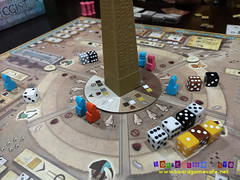
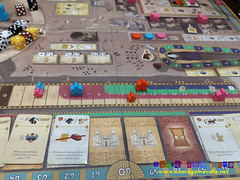
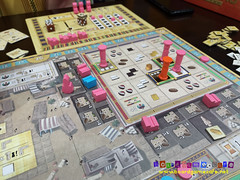
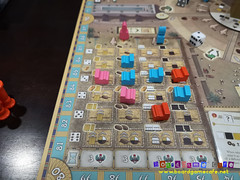
Rikka is from the makers of Tiger & Dragon, which I greatly enjoyed. The use of mahjong-like tiles is nice. Although not absolutely necessary, it does make the game experience better.

You can consider Rikka simplified mahjong. It does feel like mahjong, but there are some important differences. You start with a hand of 5 tiles. On your turn you take a tile then discard a tile. Tiles in the game are like dominoes. They have two halves and each half is a number between 1 and 6. Numbers are expressed as firework patterns. You win a round by making a valid 6 tile combo. There are three possible combos, with different point values. You play multiple rounds and win the game at 10 points.

All tiles in the centre start face down. When you draw a tile, you can draw any tile, including any previously discarded and face up tile. This is very different from mahjong. You have access to more and more known tiles as the game progresses. Another interesting twist is when a player wins a round, other players may also score. If someone else wins, but you are only one tile away from winning, and there is one face up tile that would have allowed you to win, you will score too, as if that tile is in your hand. Due to this rule, you can choose not to win yet when there is such a tile, and wait for an even better tile that will create a better combo for you. The downside of doing this though is you are giving your opponents more time to make combos too. With this rule, it is possible that a player who only scores but does not win scores more points than the player who wins. You certainly don’t have this in mahjong.

The three combos in the game have one common requirement – the bottom number must be the same. You can rotate and rearrange your tiles at any time. If the top numbers make a perfect sequence of 1 to 6, your combo scores 6 points. If your top numbers make two sets of numbers in sequence, your combo is 3 points. Otherwise, your combo with just the bottom being the same number scores 1 point.

It is important to take note of what your opponents are taking and discarding. If anyone takes a face-up tile, he must be trying to make a combo with one of those two numbers on it. When a player discards a tile, he is probably not attempting either of those numbers.

The game comes with six optional modules. You can play with any combination of them, even all at the same time. One module allows you to say uno. Well, kind of. When you are one tile from winning, you can declare so, after which you may not change any of the five cards on your rack. If you draw a tile and you don’t win with it, you cannot keep it and discard another tile. You must discard it. If you win the game after having made such a declaration, you gain an extra point.
Another module is the direct hit. If you discard a tile which another player can win with, he declares so and wins immediately. In this case he doesn’t take points from the bank. He takes the points from you! With this module, you have to play much more carefully and defensively.

I find the game enjoyable. It’s certainly much easier to learn than mahjong, but it still has many fun aspects of mahjong and more. This is a game in which you must consider what your opponents are trying to do. Since you can take any face-up tile, it is possible to switch to collect tiles of another number if you see many tiles of that number being discarded. You only need six tiles. In one game we played, Chung saw that no one wanted any 4. The rest of us knew he was trying to collect 2’s, and we deliberately avoided playing any 2’s. He switched to collecting 4’s, and managed to win. Maybe we should have taken some tiles with 4’s to stop him. But then we would be spoiling our own hands.
The game is short and easy, yet there are interesting decisions to be made. There is certainly some luck. Sometimes you keep drawing the tiles you need. The fun is in taking a gamble when both of your options seem equally viable. You need to consider risk and reward. Do you go for an easy win, or do you attempt to make a strong combo. This game gives me an urge to buy Tiger & Dragon.
Categories: Reviews