Pan Am is a 2020 game by Peter Lee and Prospero Hall. One thing I find interesting about Prospero Hall is they are a whole team of people designing games together. They have been involved in many games, including several big titles. I think they work on not only the game mechanisms, but also the whole product design.
The box cover of Pan Am certainly caught my eye when it first came out. Early reception seemed to be lukewarm. So I didn’t follow it. Recently I listened to a podcast which gave it high praises, and that made me curious. Julian has the copy, so I managed to give it a try. We played with an enhanced version of the game. Spielbox magazine released a set of tweaks developed by the designers. So I guess this is v1.1 of Pan Am.

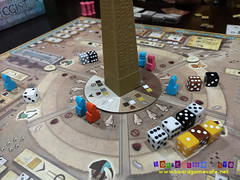
The first thing I noticed about the game was how the world map looks different. I like this, because it’s cool to be different. But more importantly, this layout is more practical for gameplay purposes, making better use of space.
Pan Am is a worker placement game. There are five sections for worker placement, and there are different numbers of spots. Each section lets you do something related to building your airline business. The worker placement mechanism is combined with a bidding mechanism. At some spots when you choose an action, you must specify how much you are willing to pay for it. You can decide to spend $0, but if another player wants the same spot and is willing to pay more, he will kick your worker out. If you want to guarantee your placement, you have to pay a high price. Or maybe you are just taking the free spot to force the desperate guy to pay for the action.

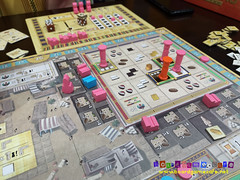
Your humble starting fleet of three airplanes
The goal of the game is to have the most shares in the Pan Am company when the game ends. You will be running your our little airlines to make money, and at the end of every round you can spend money to buy shares in Pan Am. Throughout the game the share price will generally go up, so it’s often a tricky decision to spend money to buy the shares now while they are still cheap, or to keep the money to develop your own airline business in order to earn even more money. Pan Am is the giant in the industry. The most important mechanism in the game is how Pan Am will buy your routes and pay you money. This is the most effective way to make money. How Pan Am will grow its network is predetermined, but how quickly it expands is randomised. Generally you want to build routes where you know they will expand to, so that you can make money from them.

You will spend much time building routes. To be able to claim a route, you need several things. You need to have landing rights at the cities at both ends. You also need to have an available aircraft that can cover the distance between the two cities. Routes go from distance 1 to 4, and your initial planes can only do distance 1 and 2. Level 3 and 4 planes only become available later in the game.

Taking city cards is one of the actions in the game. City cards are landing rights. If you own a card, it means you have landing rights. It is not easy to get the exact two cities you want for a specific route. Thankfully here is some flexibility with these city cards. If you don’t have the exact city card, you can use one from the same region (which has the same colour), but you will have to discard that card. If you don’t even have a city card of the same region, you can discard two cards. This is a costly thing to do.
Another way to have landing rights is building an airport. Once you build an airport at a city, you have permanent landing rights. At most one airport can be built per round, and competition can be fierce.
Claiming a route is an action you have to perform once you have all the ingredients ready. When there are people fighting for the same route (which happens often), this section becomes a priority.

This die represents the most exciting part of the game. At the end of every round, you roll this to see how Pan Am expands. If it expands to a route you have already claimed, they will buy that route from you, and you will make money. This does reduce your income level, but you get money now, which is always a good thing. When Julian, Han and I played the game, we all cheered happily when the die roll went our way. The Pan Am logo side (see above) is the best result. When this is rolled, everyone can sell any one route to Pan Am, ignoring Pan Am’s pre-set expansion plan. This is when you get to sell those high valued distance-4 routes which are not in their plan.

Pan Am starts in Miami, and expands in three different directions. Whenever it expands, you place its logo on the route it claims or buys from a player.

Every round an event card will be drawn. An additional rule may come into play. Event cards also affect the Pan Am stock price and how much Pan Am expands, i.e. how many times you roll the expansion die.

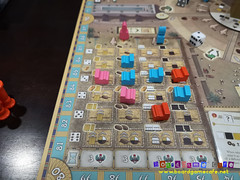
These gear sticks are your workers. Notice that next to each city card there are four spaces. You place your worker on the price you are willing to pay. If you must have that card, place your worker on the most expensive spot, and no one else will be able to kick you away.

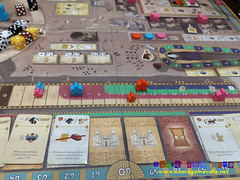
Every round there will be three special power cards made available. Many of these are strong. They often allow you to break some rule, or they give you a big bonus.

The four plane levels

This was late game and Pan Am had expanded far
Playing Pan Am is reliving the heyday of air travel. This game tells the story of how modern airlines came to be. It is greatly simplified, but there is still much historical flavour. Cashflow is always tight and the competition for worker placement spots is intense. The game is highly interactive. Pam Am is a well executed mid-weight strategy game.
~~~~~
For more posts visit hiewandboardgames.blogspot.com, http://www.facebook.com/hiewboardgameblog or (in Chinese) boardgametable.blogspot.com.
Categories: Reviews