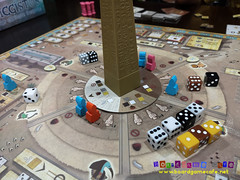

Expeditions is the sequel to Scythe. It is an independent game, set in the same universe – an alternative 1920 Siberia with giant mechas. The war (which happened in Scythe) is over now, and there is peace. A giant meteorite has crashed in Siberia, awakening ancient corruption. Expeditions to the site did not return. Now it is your turn to launch a new expedition to the crash site. Each player leads a different team. You are going in to discover, to suppress corruption, and to gain techs for your nation.

The map is set up with about one third of tiles face-up, and two thirds face-down. The face-down tiles are the meteorite crash area which you have to explore. You start the game with a mecha, a character, and an animal companion. Your mecha is represented by both the beautiful pawn on the map and your player board. Your character and companion are two starting cards in your hand. All three elements are unique in the game. Together they are a set and they are your faction.
There are three action types in the game – you can move, you can play a card, and you can gather, which means using the ability of the tile you are on. Most of the time you can only perform two different action types. Next turn you must do a different combination of two actions. You can forgo a turn to reset. When you do that, on your next turn you can perform all three actions. The reset is important because you need it to bring played cards back into your hand. This core mechanism provides an interesting challenge. You have to plan around this to make the most of your actions.

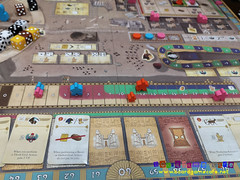
There are many things you can do in this game. When you move to a face-down tile, you turn it face-up and collect the map token on it. You discover what benefit that tile offers for the gather action. There will be one or two types of corruption on these revealed tiles. Another thing you can do is to spend resources to vanquish corruption. When corruption is completely vanquished from a tile, a stronger benefit will be unlocked. Tiles offer many different types of benefits. Those tiles which are already visible from the start offer basic benefits, like workers or cards. More advanced benefits are only available on the initially face-down tiles.

These two above are starting cards. When you play a card, you get the resource at the top left. If you attach the right worker to it, you get the benefit at the bottom as well. Cards played need to be taken back into your hand using a reset or some other tile or card ability before you can play them again. You will be able to gain more cards during the game, and there are three types of cards – quest cards, meteorite cards and item cards. They can be used just like your starting cards, and they can also be tucked under your player board using specific actions offered by tiles in the game. The upgrade action lets you tuck items on the right. The solve action tucks quest cards above. The meld action tucks meteorite cards below. Cards tucked give you long term benefits.

When you reach certain achievements, you can perform a boast action to place a glory token (star). This is very much like Scythe. For example when you have tucked four cards under the right side of your player board, or you have 8 cards in hand, or you have vanquished 7 corruption tokens. Glory tokens you place will be worth points. The game ends when a player places his fourth glory token. Items cards, corruption tokens are worth points too. During the game itself you may also score points from certain actions.

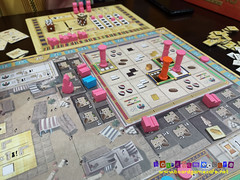
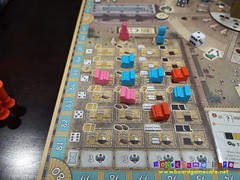
This is the player board
Expeditions is a game about exploration and upgrades. There is a wide range of things you can do, and you probably want to focus on just some and not all. You may not even be doing much exploration, as long as there is someone doing enough of it to reveal tiles that offer the better actions. This is an efficiency game. You will likely spend some effort on upgrading your abilities, even if you don’t intend to go for the related glory star. Eventually you have to decide which glory stars to go for. If you are first to get the fourth star, it’s a good position to be in, but it doesn’t guarantee victory. It depends on how well the others are doing.
You don’t fight the other teams. However you do block them from occupying the same tile. They can move through you, but they can’t stop where you are camped. This is sometimes crucial, for example when you are competing for the boast action on a tile in order to place your next glory star. Another thing you will compete for is the cards. There are five face-up cards. Usually you want to get four cards of the same type, i.e. those which can be tucked under the same side, because you need four of them to qualify for a glory star. If another player is going for the same card type, you will have competition.

I like Expeditions more than Scythe. Titles from Stonemaier Games never really click with me. I don’t dislike them, and many of them are decent. It’s just that they feel only okay to me. I can see there are some clever ideas, like how the player boards in Scythe work. Scythe is an okay game for me, and Expeditions is an okay game too, but I like it a little more. I enjoy the efficiency puzzle of working within the constraints of the core action mechanism and making the best of the cards I have and the tiles within reach of my mecha. The game feels mostly solitaire. Sometimes for long stretches you don’t bother with your opponents. I find that I don’t mind it too much. Maybe I’m very absorbed in my own race to get all my glory stars out as quickly as possible. The process to decide which glory stars to aim for is interesting to me. You shouldn’t decide up front. You have to watch how the game develops, and then decide which will be easier. Sometimes opportunities present themselves, and you go with the flow.
~~~~~~
For more posts visit hiewandboardgames.blogspot.com, http://www.facebook.com/hiewboardgameblog or (in Chinese) boardgametable.blogspot.com.
Categories: Reviews