
Human civilisation has collapsed for thousands of years. Earth entered a long ice age. You are part of a community that has survived and hidden underground for generations. Now it is time to return to the surface and to rebuild civilisation.

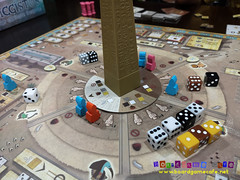
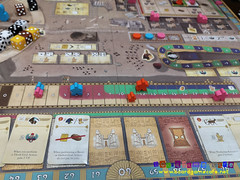
This is the main board. This was far into a game. The game starts with just a hole in the middle and a few tiles around it explored. That hole in the ground is where you emerge from your underground base. Most of the board is face-down tiles waiting to be discovered. As you play the game, you will construct buildings and and send people out to settle spaces around the central hole. You explore further and further towards the edges of the board, reaching out to the four ancient settlements in the corners. When you reach certain achievements you will be able to claim those large oval artifacts near the top. These are worth points. The game ends when the last artifact is claimed.

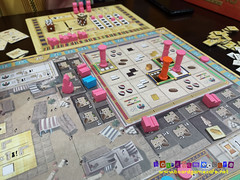
You have two player boards and they look like this. The bigger board is mostly your tech tree. There are three tech paths you can advance on – yellow, green and grey. When the tokens reach certain positions, large chambers are unlocked, allowing you to move the light blue discs to your score track. You also get to place a technology tile into the unlocked chamber. Your tech tree is customisable.

To advance on the tech tracks, you need to construct buildings on the main board. There are yellow, green and grey resource spaces on the board (they are fields, forests and mountains). When you build next to these spaces, you get to advance on the corresponding tech tracks.

You have cards. When you play a card, you tuck it under slots on your player board. You have two slots that let you use the top part of cards, and two slots for the bottom parts. There is a fifth slot you can unlock, and you can use it for either part of a card. Playing a card can get you resources. Many cards have other abilities, like advancing tech and converting resources.
Once in a while you will need to hibernate. That means doing a reset. You move cards from the slots to a discard pile, so that the slots become available for use again. You also take back previously used cards. Cards that have been used in the current round go to a rest area. They only come back at the next hibernation. During the game you can get new cards. So there is a little deck-building here.

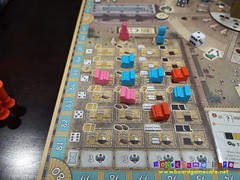
This is the smaller player board – the faction board. Every faction has a unique ability, shown along the bottom. Every time you use this ability, you move a light blue disc to your score track. This increases your points and also gives you energy for operating machines. Your people are placed on this player board. Whenever you send people out to settle the land, you gain some benefit.

You will gather resources and then spend them to discover new tiles, construct buildings, settle people and upgrade your techs. Among players you will compete for space for buildings. However your people can coexist and you can settle the same spaces. There is a small mechanism which allows collaboration. You can use an opponent’s played card, and when you do that, the card immediately goes to his discard pile. You get something for free, and he gets to take this card back at his next hibernation, saving him one hibernation cycle.
The player interaction is mostly along the lines of grabbing stuff faster than your opponents. There is some spatial competition. Every time you need to construct a building, there is a distance cost, based on the nearest building. That means if you grab a strategic location, you are making it more expensive for your opponents to expand in that direction. It may not be prohibitively expensive, but at least it’s an annoyance. Taking good spots that help with advancing tech levels is probably a bigger annoyance.
I feel I have played too many similar heavy Eurogames like this. Or maybe I feel so because my gaming tastes have shifted away from heavy Eurogames. I see many Eurogames as complex exercises in gathering resources efficiently then converting them to points. Player interaction is mild. You are mostly doing your own thing. I find this a pretty typical heavy Eurogame. There is some engine-building. You get to do some things that improve your actions, and thus your efficiency. You can customise your strategy. You feel clever when you figure out how the game works. If this is a genre you like, you’ll probably enjoy this more than me.
One of the designers is Kristian Amundsen Østby. I have enjoyed Escape: Curse of the Temple and I greatly admire Santa Maria. His latest game Timespan is getting a lot of buzz too. If you like his other games, this is worth checking out.
~~~~~
For more posts visit hiewandboardgames.blogspot.com, http://www.facebook.com/hiewboardgameblog or (in Chinese) boardgametable.blogspot.com.
Categories: Reviews