Limit covers a serious topic. It is a simulation of modern human civilisation. It is based on the Meadows Report “The Limits to Growth”, which says that because our planet and its resources are finite, constant growth is impossible. We will sooner or later hit a saturation point. Yet humans behave as if there is not such limit. Every corporate CEO is expected to achieve ever higher results. We chase the newer phone, the fancier car, the bigger house. The game is designed with an intention to make people think about how we behave as humankind.
In the game, each player manages a nation over several generations, beginning from 1850, i.e. the start of the industrial revolution. You manage food production, consumer goods production, weapons production, the quality of life of your people, social unrest and your population. All if this is done using a card drafting and card play mechanism. You can trade in the global markets. Your actions have various consequences.

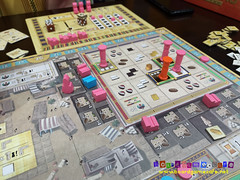
This is your player board. The green, blue and red tracks are your production levels for food, consumer goods and weapons. All aspects of your nation are represented here.

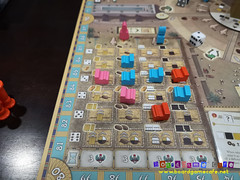
This is the quality of life of five classes of your society, from richest to poorest. You must improve the quality of life of a richer class before you can improve others below it. It is possible to try to give everyone a similar quality of life (like the above), or you can also choose for the richest to have a good life while the poorest suffer. Different rules and abilities apply depending on the quality of life levels of Classes A, C and E. That is why you may want to have specific classes at specific levels. Class A having a higher quality of life gives you more options in picking policies. This helps you better govern your nation. The quality of life of Class C affects the consumer goods being consumed by your nation and also the birth rate. At the end of the game, Classes A, C and E contribute to your score.

This is your population level and your social unrest. Quality of life affects population growth, and population in turn affects how much food and consumer goods you need. Social unrest is on a scale from Boom to Growth to Uprising. Various things you do affect social unrest. Naturally you want to avoid hitting the uprising positions.

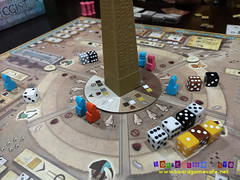
This is the central board, and it represents the global market. Food, consumer goods, weapons and fuel are bought and sold here, and prices are influenced by player actions. The bank in the game is called the IMF. It has a lot of money, but it might run out of money and trigger a financial crisis.

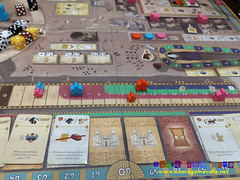
These cards are the meat of the game. You start the game with some basic cards, and every round you may get some new ones. There are three decks in the game – society, production, and military / economy. Which deck you choose to draw from determines what kind of cards you will get. In the action part of a round, players take turns playing cards. Generally these cards help you build your nation and tweak it in different ways. Some cards allow you to attack other nations, like this one below.

I played the game on BoardGameArena.com. I must admit I didn’t have enough patience to remember all the rules. I played by gut feel and let the computer handle the consequences of my actions. I took a communist path, or at least that was how I perceived myself. I kept the quality of life as equal as possible for all social classes. I did have to increase Class A first, but once it is one notch above the rest, I prioritised improving the quality of life for all the other classes before coming back to take care of Class A again. I knew there would be some drawbacks, but I just stuck with this. It turned out to work well for me. I think I was lucky with the cards I drew. They synergised well. I didn’t pay attention to the other players. They seemed to struggle a bit.
My population grew. My production capacities grew. I was strongest militarily. I was a little tempted to attack others, just to see how it worked, but eventually I didn’t because it felt cumbersome. Since I was already ahead (at least I thought so then), I didn’t need to use military to get ahead. I did start to run out of land. If I could capture others’ territories it would help me continue to grow.
Our game ended because we had four crises. The other way the game ends is completing 7 rounds. I was a little surprised that one of the crises worsened my social unrest so much that I went into uprising. I had been managing my social unrest pretty well. At one point, all my social classes had the max quality of life. I was pretty pleased with myself. I did right by my people. However I was shocked to find out that I did horribly at the final scoring. I had too much pollution and lost many points for that. My people still had the best quality of life, but my population was low so that didn’t give me many points. I should have paid more attention to how scoring worked. Jia Yaik made a lot of money and that gave him many points. Eventually it was Jon who won because he was well balanced and screwed up the least.

I think the intention of the game is we are supposed to try to survive and hopefully thrive till the end of the 7th round. If we trigger four crises before that, it feels like we have lost because we have mismanaged our planet. This is a game with a lot of rules. Many elements of your nation affect others. This is a complex simulation and you do a lot of housekeeping. It is like work. This is actually a lesson about nation-building and international geopolitics. I find it a little tiresome to learn the rules. It takes a fair bit of effort to fully understand all the implications of your choices. Yet, I have some curiosity to see how we can survive till the end. If I’m going to play this again I certainly need to have more discipline in understanding it better. Most of the time the gameplay feels solitaire. You are managing your own nation. Actions at the global market do affect other players, but that interaction isn’t that strong. Military actions affect opponents more directly, but it depends on whether players use them much. I am tempted to try this just to see whether we can last till the end.
Categories: Reviews