Lightning Train was described as Ticket To Ride with deck-building, but I think that will paint an inaccurate picture. It is indeed played on a map of USA, and you do compete to build tracks between cities. The core mechanism is indeed bag-building (a form of deck-building). However I find this a much more complex game. It’s a mid- to heavy-weight game.

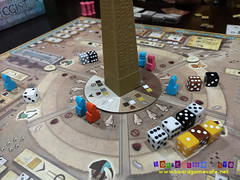
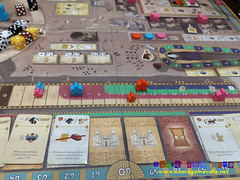
This is the game map. In this game you will be laying train tracks, building train stations, and delivering goods. One important project which everyone is working on is completing the transcontinental railroad connecting New York and San Francisco. The game ends when this is achieved, or at the end of 12 rounds. Several things that you do score points. When the game ends whoever has the highest score wins.

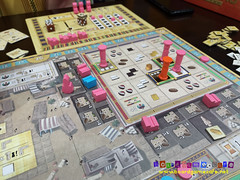
This is the player board. The two red backed cards on the right are secret objectives. If you complete them, you will score points. Some of them are like Ticket To Ride. If you can connect specific cities, you score points. There are other types of objectives too. Your player board has various slots for placing train carriages. Whenever you fill a section, you get to use the action or benefit specified. The two sections at the bottom are upgrades. When you upgrade, you gain permanent abilities.

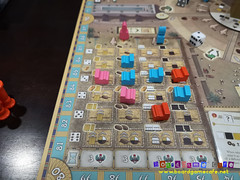
These tiles here are the bag-building mechanism of the game. You have your own bag of tiles, and every turn you draw five to place in this section of your player board. There are five regular spots, and once you fill them all (like in this photo above) you stop drawing tiles from your bag. These tiles you have drawn allow you to perform actions. Money lets you buy new tiles. These new tiles go into your bag the next time it is exhausted. The train carriage with a lightning icon means you immediately take a carriage. You can see I have taken two. These carriages can be placed in sections of your player board to do various things. If you don’t have enough, you can keep some here for actions in future turns. Carriages can also be used to lay tracks on the main game board. The goods icon let you deliver goods. The non-white tiles are contracts. You need contracts of specific regions to be able to lay tracks or build stations in them.
Notice that two spaces on the left have a plus sign. Some tiles have a plus sign, and they can be placed in these special spaces. That means you may be able to draw more than five tiles on your turn. You can upgrade your player board to get two more plus sign slots. In the best case you can draw and use nine tiles.

The round tokens are goods. There are several types. During game setup, some are already placed on the map. Every round, some are added. Stations that are build have one or two demand icons. You can deliver the goods they need to them. Once the demand is satisfied, the station no longer wants this good type. When delivering goods, every stretch of train tracks used scores one point for their owners. The owner of the station scores a point too. This is one way you score points in the game.

You will start on the eastern seaboard. There are five cities here which allow you to start building tracks. Also initially you only have contracts for the three regions in the east. To build beyond that, you will need to buy new tiles which are contracts for other regions.

I did a four-player game, and our progress felt slow. We didn’t seem to be racing towards San Francisco. Maybe it was because we were all new to the game, and we needed time to digest how the game worked. This is certainly more complex than Ticket To Ride, so I feel like I need to do a lot of work to build just one stretch. Laying tracks and building stations are restrictive. You need to have drawn the right tiles with the right contracts. You need to have enough trains drawn that turn. You can only save one train from the previous turn to use for laying tracks. You cannot lay tracks anywhere you want. They must extend from your existing tracks or from a station you own.

We did eventually manage to connect to San Francisco. That triggered a one-time bonus scoring. In our case since it was a four-player game, the game did not end yet. We needed to connect to both Houston and Seattle to trigger game end. We did not manage to finish our game because it was late and one of us had to leave. We didn’t have any obvious leading player at that point. Our scores were close.

Lightning Train is not that complex once you understand it. I had fun buying tiles and seeing how they helped me on future turns. The tile market works like Ascension. There are always six tiles available, and whenever one is bought, the market is refilled with a random new one. I’d call this a deck-building game with board play instead of a boardgame with deck-building. The deck-building part drives what you can do. You must buy smartly and coherently in order to be able to execute the strategy you have in mind. There is tactical competition in claiming routes and delivering goods. You need to fight for these. One fun element in the game is how you keep improving your abilities. Buying better tiles let you do more within the same turn. You get to upgrade your player board too. You unlock some abilities when you build stations and when you surpass certain victory point thresholds. There is a satisfying feeling of acceleration.

I has been a while since I joined a BoardGameCafe.net Friday night session. I used to be a regular, showing up almost every Friday. That was up till before the pandemic. After those few years of on-and-off lockdown, I got busy with other things and now don’t game as much as before. It’s nice to be back learning a new game in person and playing with others across a physical table.
Categories: Reviews