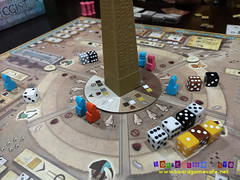
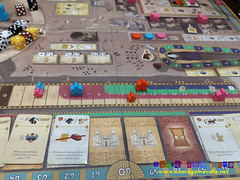
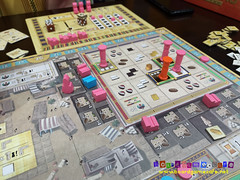
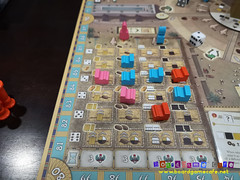
Choon Ean and I were at Kinokuniya bookstore (Pavilion Damansara Heights) demoing our games over the weekend of 30-31 May 2026. This time our tables were occupied more, compared to two weeks earlier when I was there by myself. There were people who stayed to play for quite long. It feels great to see people enjoy my games and want to play again and again. That weekend I think I sold out all the copies of Ali Baba and the Forty Thieves at this Kinokuniya branch. At least I didn’t see any more left. Not sure if they still had some in storage.

My friend TS Tan visited, bringing his family. This was the first event I used my new apron. The colour is not the same red as my Cili Padi Games logo, but I quite like it.

This was my setup.

Jon had an ad hoc game session at Lolla Paluza cafe on a Tuesday which was a public holiday (replacement for Agong’s birthday, which was offset by the replacement for Wesak Day). This was one of the games we played, Martin Wallace’s Hit Z Road. It’s a zombie game, and it’s an auction game. Yeah, this sounds weird, but the game works pretty well.

The currency in the game is bottle caps. There are three types – ammunition, fuel and adrenalin.

Every round there are as many pairs of encounters as there are players, and the players bid for turn order to pick a pair of encounters. Encounters are a mix of good and bad. As the game progresses, they get worse – more zombies, fewer resources, more types of dangers. I think we bid too much. We spent a lot of resources to try to avoid bad encounters. When bids go high, it’s bad for everyone. We have fewer resources to help us survive and fight the zombies.

I was the first to lose all my people and thus lose the game. It happened in the second last round. Jon and Ji Li lost in the final round. Darryl was the only player who managed to survive and get to California.

One of the encounters.

The Collectors Court event was held at the Summit USJ mall over the weekend of 6-7 Jun 2026. This was mostly focused on trading card games (TCG’s). Jon and Haireey had booths there. There were tables made available for playtesting. The Design & Play game design competition is ongoing now. Jon, Haireey and I are part of the judging team, together with Chee Kong, Logan and Buddhima. Contestants were encouraged to come to the event to playtest one another’s games. We the judges also brought our games to be playtested, even though they were not contest entries. News at 8 is Haireey’s prototype. I have seen it being playtested several times, but this was my first time trying it. By now it is already different from the earlier versions.

Every round, one player needs to perform. He reads a news item, and depending on the intensity card he draws (which the other players cannot see), he needs to fill in some blanks to convey the intensity level (or newsworthiness).

Intensity goes from 1 to 10, so 8 is high.

The guessing players need to fight for these number tokens. There is only one for each number. You need to grab the one you think is the correct answer.

This is Vinod’s prototype, a game about matchmaking. It will be released by I-van under Roll Rebellion. It is a simple game for casual players.

To win the game, you need to find bride and groom of matching colours, a date which matches their colour, and also you need a priest.

On your turn you draw two cards, one after the other. You can take a card for yourself, or you can give it to someone else (they must accept). This is a game where you can mess with your friends a lot. The fate cards have all sorts of powers, some good and some bad.
Playing this game and observing it being played gave me much food for thought. This is a very simple game with plenty of luck. It is not my type of game. However in the same game I played, I noticed how much others enjoyed it. People liked the setting. I-van’s HR Game has been hugely successful in Malaysia. Also a simple game, and also not my type, but it has been very well received. I think I-van has made a good pick with Vinod’s matchmaking game and I think it will do well. When I choose which games of my own to publish, I have been moving towards simpler games, which I hope will get more acceptance by the Malaysian general public. My first published game Dancing Queen is the most complex, and my fourth, Pinocchio, is the simplest. The next one, Pilgrim Poker, is not as simple as Pinocchio. It is roughly at the Ali Baba and the Forty Thieves level of complexity, i.e. not very complex. I have a weakness in making simple games. I do try to make my games as simple as they can be, while still offering something unique, or a least some twist. However I can never quite make a truly simple game that the casual crowd will immediately like. I hope Malaysian Holidays can be something like that, but even then I think I have some rules that will require some effort for non-gamers to digest.
Many contest entries for the Design & Play competition were playtested at the Collectors Court event, but I did not get to try many of them, because I couldn’t stay long. It is encouraging to see many people actively participating in the playtesting session.

Jeixel brought his contest entry, a game about lousang, a Chinese custom during Chinese New Year, practised by Malaysian and Singaporean Chinese. Lousing is about tossing various food ingredients to bring good luck. In the game, you mix the cards and make a messy pile at the centre of the table. You then drop dice to claim ingredient cards. When Jeixel explained the rules to us, my first thought was “What? That’s it?!” However once we started playing, this turned out to be more challenging and more fun than I had expected. Those dice that you drop, most of the time they roll away, forcing you to take a different card from what you originally intended. Sometimes they roll off the card pile and you get nothing. You can try to knock your opponents’ dice away, and this happened a lot in our game. If two players have dice on the same card, it is the higher valued die which wins. Very simple concept, which didn’t sound like much at first, but once I started playing, I was pleasantly surprised.

Each card is 1 point.

When you have three of a kind, you get +2 points.

I asked others to help me playtest my Dream of the Red Chamber (红楼梦) game. I have a nagging feeling that it is too simple. Maybe I should not think that way. Simple is good. Now I am experimenting with adding a bit more to the game. This might be my next game for 2027.

The green cubes are a new element. When you play a meld, if the exact same meld has been played before, whether by yourself or by other players, your latest meld scores a bonus 1 point for each previously played meld. At the moment this little new rule seems to work okay. People don’t find this difficult to remember, and it adds a little bit of strategic consideration. Players may hold back on playing a meld, hoping someone else will play theirs first. Is this absolutely necessary? Maybe not. This might end up being a variant.
Another rule change I have playtested is giving Jia Baoyu (the 0 card) a special power. If you don’t play a meld on your turn, you may discard JBY to take any card from the discard pile. This can be a very powerful move if you are short of just one card for a big meld. However, JBY is often a very important card you need for big melds too. So using it for its power is not something you take lightly. I’ve only playtested this once. The players did use it. I’m not sure yet whether this is a good addition.
There are other more complicated additions I am toying with. In the game there are 11 types of melds. I have a little board listing them all. When you play a meld, if this is the first time in the game this meld is played, you mark the board with a cube. Every meld in the game refers to a chapter in the book. The characters required for a meld are the main characters in the corresponding chapter. Instead of playing 3 rounds, the game ends after all melds have been marked. This is thematic. The story is complete after all chapters are covered. But this might be tedious. I’m not sure whether the experience is worth the tedium.
The next addition is also related to marking melds off. The player gets a bonus 1 point whenever the 2nd, 4th, 6th etc meld type is marked. Whoever marks the 11th meld type gets 2 points. This mechanism introduces a new layer for planning. I have not tried this, and I am already worried it is tiresome.
Another one related to marking off melds – the ironman rule. Every meld can only be played once within the same round. If someone else has played a meld, you can’t play it any more. You don’t need a central board to track this. You just need to check the melds in front of other players before you play any meld. This might be an interesting variant. If someone has already made the strongest meld (11 points), if you have been working towards that, you are forced to switch tact. There will be some anxiety because the melds are first come first served.

I have just started playtesting my Water Margin (水浒传) game. I am trying to make this a negotiation game. One key concept in the story of Water Margin is how those 108 main characters are stars fallen from heaven. They are the chosen ones. Now if I imagine myself in that world, in a bandits’ lair with lots of outlaws, how would I know who are the fated 108 and who are not? Everyone wants to be the chosen one. So the game is going to be about being the chosen ones.
My initial idea is that all players must play a card simultaneously, and they want to plan such that all their cards added up will make 108. If they can achieve this, everyone who has contributed cards scores points. If they go beyond (i.e. go bust), then some cards are discarded, and those who are forced to discard cards lose points. Some cards have special powers, e.g. being able to remove another card, being able to double the points of another card, and being protected against attacks. This is not a cooperative game, even though every round you generally try to work together to achieve the 108. Ultimately it is everyone for himself. You will want to discard your sworn brother’s card if it’s going to score him many points.
I have playtested two versions of my game, and the big big problem is this – too much math. I made the card values 0, 4, 8, 20, 40, and 80, hoping to make the math manageable. However it is still too much. Too tiresome. For my next iteration I will completely remove this math part. The negotiations, the discussions, and the coordination before committing a card, all seem to work reasonably well. You have to rely on others, but you know no one is your friend.
In the next version, instead of every card being numbered, I’m just going to have some cards which have a “1”, some with a “0”, and some with an “8”. To “achieve 108”, you need to have exactly one each of these numbered cards in play. If any number appears twice, there will be penalties and cards will be discarded. Doing it this way will be much simpler. No more math.
~~~~~
This post was first released on https://hiewandboardgames.blogspot.com.
Facebook: https://www.facebook.com/hiewboardgameblog.
In Chinese: https://boardgametable.blogspot.com/.
Categories: Designer Diary